
A Case Study of Our Client, Aigul
To protect her privacy, we have changed the client's real name!
How we helped our client in the medical field meet her publication requirements and earn the title of associate professor.
Our client is Aigul, a doctor and professor at a medical university in Kazakhstan.
She was preparing to apply for the position of associate professor. In terms of her years of experience and the basic requirements, Aigul had already met all the criteria.
All that remained was to finalize the publication section:
- several articles in the KOKNVO MNVO of the Republic of Kazakhstan,
- And the hardest part was getting international publications indexed in Scopus, which she didn't have at all.
And that's when a classic situation—one familiar to many medical professionals—began
🔸 KOKNVO MNVO RK: Some of the publications were included, but we needed to remove a couple more articles so there would be no questions about the total number.
🔸 Scopus: Aigul had a “gap”—she didn’t understand how to publish properly; she tried submitting her work on her own, but kept getting rejected.
The main reasons for rejection were not “poor research,” but rather the formatting and standards, which are actually very strict in medicine:
- Vancouver style in bibliographies and citations (and there are dozens of sources where a single error means a loss of credibility),
- She tried to conduct a systematic review, but ran into difficulties with the methodology,
- PRISMA (the required framework for systematic reviews in most Scopus journals),
- And the worst part is: a systematic review usually has at least 50–80 sources, and formatting everything manually according to the Vancouver style is a nightmare.
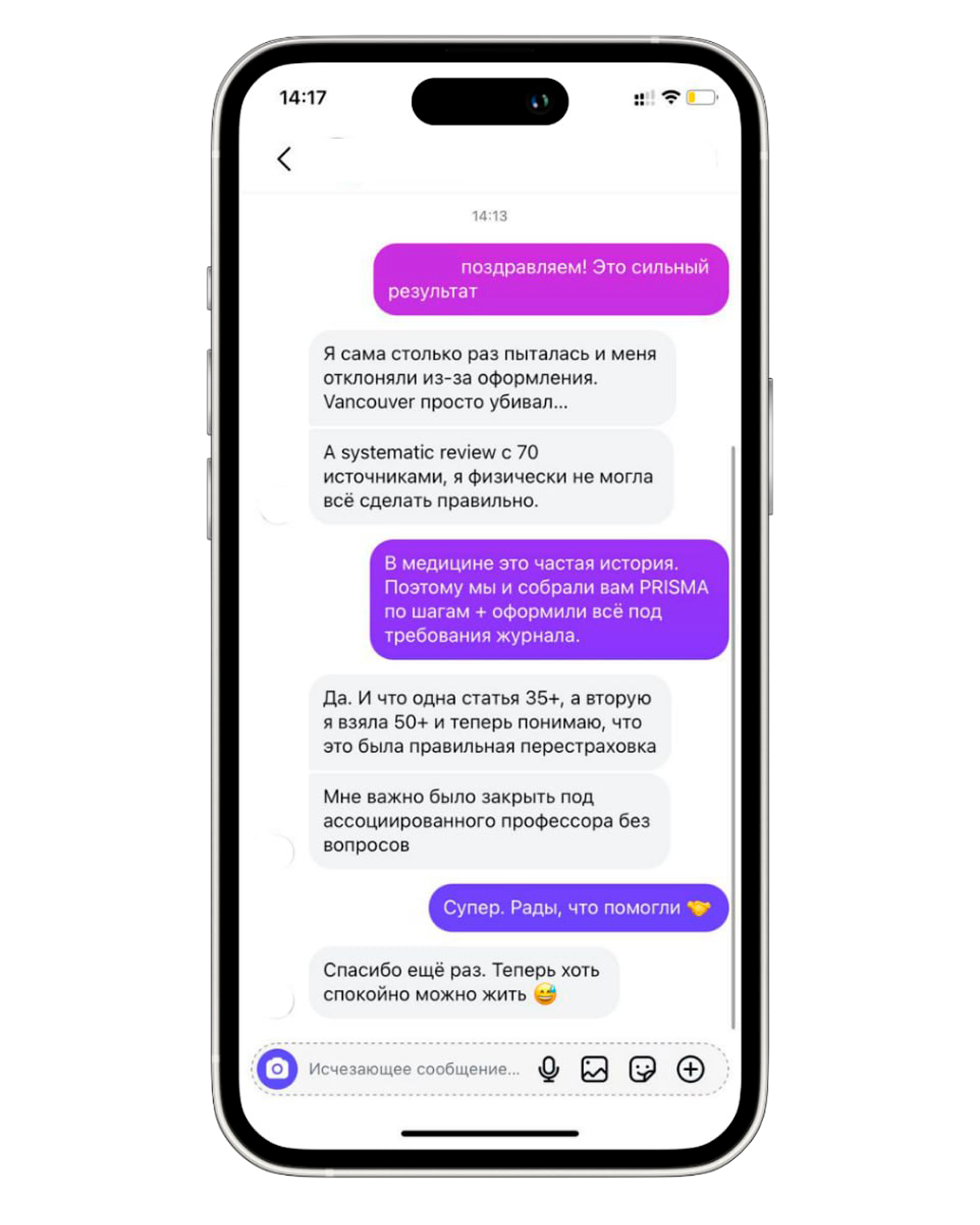
Aigul herself said, “I physically can’t handle it all: the clinic, the department, and those 70 sources on Vancouver…” And that’s exactly why she came to us—because we specialize in medical Scopus publications, where standards are everything.
We've developed a clear strategy for “applying for an associate professorship”—no luck of the draw and no “let's see if it works.”.
✅ First, an audit of her materials and a plan to resolve the issues:
- as for what we are recruiting for the KOKNVO MNVO of the Republic of Kazakhstan,
- Which two Scopus articles are we writing, and in what format?.
✅ Next, they eliminated the main “pain points” in healthcare:
- formatted the sources and references according to the Vancouver style,
- If it's a systematic review—we followed the PRISMA guidelines (search, selection, exclusions, tables/figures),
- prepared manuscripts in accordance with the requirements of the selected journals (structure, files, figures/tables, supporting documents).
✅ And here’s an important point: we established the correct authorship (1st/corresponding) in advance, because this is absolutely essential for applying for the position of associate professor.
We'll analyze your situation for free.
Aigul ordered the following from us:
- 2 articles in the KOKNVO MNVO of the Republic of Kazakhstan (close the internal block without any issues).
Two articles in Scopus, and she decided to play it safe:
- 1 article — Scopus percentile 35+,
- 2 articles — Scopus 50th percentile or higher (yes, it’s more expensive—but Aigul said, “I want it to be risk-free and without any questions from the committee”).
It took Aigul 8 months to close the case.
2 articles in the Code of Criminal Procedure of the Republic of Kazakhstan:
- 1 article is published every 6–7 months,
- 2 articles were published over a period of 7–8 months.
2 articles in Scopus:
- 35th percentile or higher — published within the last 6 months,
- 50th percentile+ — published within 8 months (including peer review and revisions).
Most importantly, Aigul finally let out a sigh of relief:
She stopped “banging her head against the wall” with Vancouver/PRISMA and got what she needed—publications that actually meet the submission requirements.
Aigul successfully submitted her application and was awarded the title of associate professor.
Going forward, he plans to strategically strengthen the portfolio—without stress or “due yesterday” deadlines.
Start with a free consultation: we’ll assess your situation, recommend the best strategy, and provide a realistic timeline—with no obligations or upfront payments.