
The fall 2026 defense cycle will be one of the busiest in recent years. Most three-year doctoral programs that began in 2023 will conclude in the fall of 2026—which means that competition for spots on dissertation committees and for publication in KOKSNVO journals will be higher than usual.
For those planning to defend their thesis in September through December, July marks the start of the countdown. Let’s take a look at what needs to be done and why the deadlines are particularly tight this year.
Real-world publication timelines that few people think about in advance
KOKSNVO does not count the publication date based on when the article was accepted by the editorial board or when it was published online as «Article in Press.» Only the date of the journal’s print issue is counted. This changes the entire planning process.
Average time from submission to publication, based on data from 2025–2026:
| Magazine | Time from Submission to Publication |
|---|---|
| MDPI Q1 | 6–8 weeks |
| IEEE Access Q1/Q2 | 4–6 weeks |
| Frontiers (on average) | 10–16 weeks; for some publications, up to 40+ weeks |
| Springer Nature (BMC, average Q2) | 5–8 months |
| Elsevier/Springer: Q1 Top Performers | 12–24 months |
| Social Sciences, Economics | 20–25+ weeks |
Articles that a doctoral student is only now submitting to most journals will physically not be published in print in time for the fall defenses. Only the fastest-publishing journals (MDPI, IEEE Access) offer a realistic chance, and only if the article is accepted without revisions on the first try.
Check where you are right now
Before you read on about the requirements and documents, it’s worth understanding where you stand. The Qalam AI-powered PhD defense readiness calculator, which takes just 3 minutes to complete on WhatsApp, will show you your readiness percentage and a specific list of what you need to complete by September—it’s faster than figuring out all the requirements on your own.


How long does it take to go from the application to graduation?
Even if the posts are already ready, there’s still a long process ahead:
- Department-wide meeting and preliminary defense — September–October;
- Review of documents by the dissertation committee—up to 10 business days;
- The date of the defense must be set no later than 3 months after the appointment;
- The defense itself will take place in November–December;
- Submission of the certification file to the KOKSNVO—within 30 days after the defense;
- Case processing time at the KOKSNVO is 4 months (plus up to 1 month if extended).
In total, it takes at least 6–8 months from the time the documents are submitted to the dissertation committee until the actual diploma is issued. A defense in November 2026 means the diploma will not be issued until April or May 2027 at the earliest.
What needs to be ready by September
| Objective | Urgency |
|---|---|
| The articles were published in a print issue and are indexed | Critical |
| The journal has been verified as active in Scopus (not excluded) | Critical |
| The publications definitely cover one of the five options for COKSNVO | Critical |
| Plagiarism check passed (NCGNT, originality score of 85%) | Important |
| Feedback from scientific advisors has been received | Important |
| An extended department meeting was held | Scheduled |
| The ethics committee's conclusion has been received | Scheduled |
If you're not sure exactly how to check the log status, here's a detailed breakdown: How Journals That Are «Supposedly» Indexed in Scopus Deceive Researchers.
Five Ways to Meet Publication Requirements
Starting in June 2025, the List of COKSNVO will be divided into three lists (List 1—Scopus/WoS and trusted publishers; List 2 and List 3—with reduced requirements and a higher number of articles). The applicant must fulfill one of the following five options:
- 1 Scopus article (CiteScore of 25%) or a WoS article from any quartile + 1–3 articles from the COKSNVO list (depending on the journal's list);
- 2 articles in WoS Q1–Q3 or Scopus with a CiteScore of 35% or higher, excluding publications in KOKSNVO;
- A chapter in a monograph published by a reputable publisher or a university ranked among the top 100 in global rankings;
- 1 Scopus article (CiteScore of 35%) or a WoS Q1–Q2 article plus a presentation at a conference indexed in WoS;
- 1 article in a WoS Q1 or Scopus journal with a CiteScore of 75%—no additional publications required.
Important note: Only the following formats are accepted: Article, Review, Article in Press, Conference Paper, and Proceedings. Editorial, Letter, Short Communication, and Note are not accepted, even if the journal is fully indexed in Scopus.
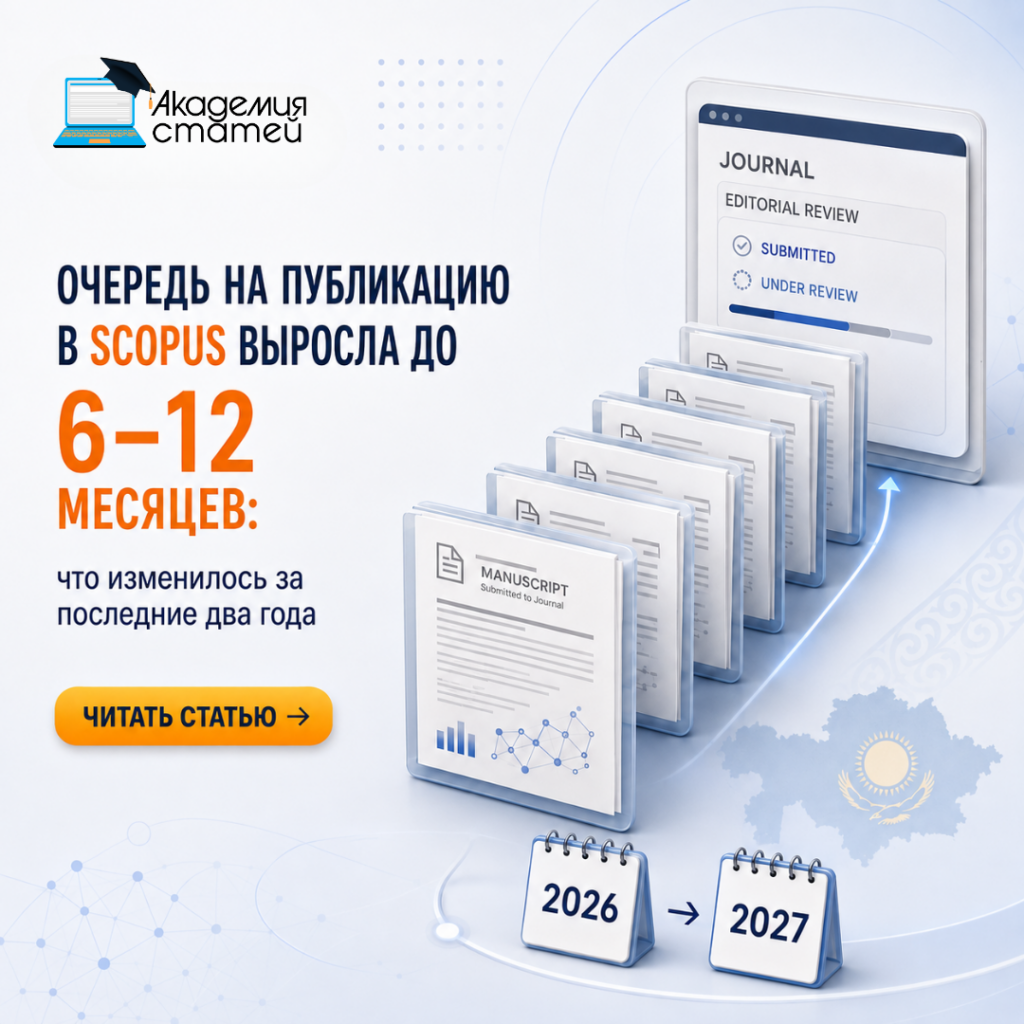
A particular challenge is the review times for KOKSNVO journals specifically: Waiting times for publication in KOKSNVO and MNVO RK journals in 2026 have increased to 6–12 months, and this must be taken into account when estimating the timeline.
Why Defenses Are Moved: Five Common Reasons
A detailed analysis of all scenarios leading to rejection is available here: Top 6 Reasons for Failure at a PhD Defense in Kazakhstan. Below are the five most common ones.
- The journal was removed from Scopus—dozens of publications were deindexed in December 2025–January 2026 alone, and articles published during the year of exclusion are not counted. How to choose a publisher that is rarely removed — journals from which publishers will never be removed from Scopus;
- The issue's publication date turned out to be later than the date the documents were submitted to the dissertation committee;
- The publication type is incorrect (for example, "Short Communication" instead of "Article");
- The publications do not formally cover any of the five options (a common mistake is having an insufficient number of COKSNVO articles for one's list);
- Plagiarism or undisclosed use of AI in a dissertation—as of January 2025, this will be grounds for rejection without the right to a second defense. What exactly are the legal consequences? — AI Detected in a Dissertation: Real Consequences Under Law No. 230-VIII of the Republic of Kazakhstan.
Conclusion
The fall cycle of 2026 will be one of the busiest precisely because it coincides with the completion of the three-year programs for the 2023 intake. The actual window of time for preparing publications has effectively closed: anything not submitted to the journal by July risks not making it into the print issue before the defense. The only viable approach at this stage is to accurately assess which of the KOKSNVO requirements have already been met and which have not, and to act accordingly in the remaining weeks.