Case study by third-year doctoral student Tukaz
Speciality: 6D010300 (Pedagogy)
How we helped publish two articles in Scopus in six months.
Tukaz is a doctoral student in pedagogy, whose dissertation topic is related to artificial intelligence in the global educational space.
⠀
She'd been following us for a long time, carefully reading the blog, studying informational posts, and following case studies. She'd had her first consultation with us before, but she wasn't rushing to make a decision—she was simply observing and considering.
Later, after reading our post "Choosing a Publishing Strategy," she re-signed up for a consultation and finally decided to collaborate.
During our consultation, we discussed all the possible options in detail. One of them was publishing in journals listed by the Committee for Control over the Environment (KKSON). But this approach proved risky:
- First, it can take 6–12 months or longer to get a paper published in KKSON journals in Kazakhstan—due to the limited number of publications and long waiting lists;
- Second, there is often no transparent review process, and delays occur at every stage;
- Thirdly, even if you applied now, there was no guarantee that the publications would be published on time – before the defense.
So we proposed a reliable and realistic strategy: publishing two articles in Scopus journals with a 35+ percentile. This was a viable option, and she was certain to meet the deadline.
The first article was written in 32 days.
The client carefully read the manuscript and provided her edits. We took everything into account and submitted it to the journal. The peer review process lasted two months, and the article was published a month later.
The second article turned out to be more complex in terms of topic; it took 48 days to prepare.
Then there are 2 months of review and another 1.5 months before publication.
The result: both articles were published within six months. Official indexing took place another month later.
✅ 2 articles in Scopus (percentile 35+)
✅ Publications before defense
✅ Indexation on time
✅ A clear plan and full support
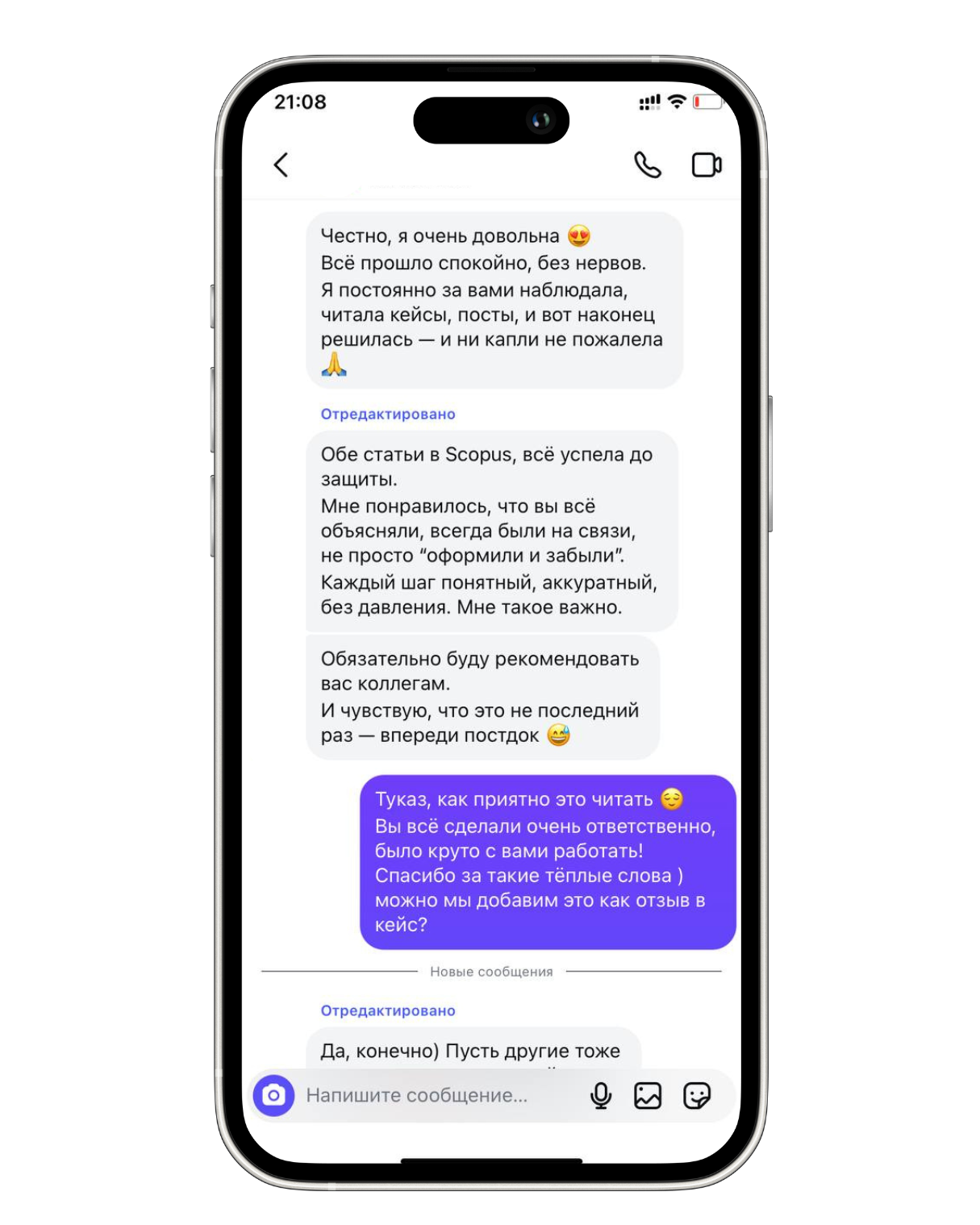
Tukaz was very pleased with the result, will recommend us to her colleagues, and is already planning her next step: enrolling in postdoctoral studies and becoming an associate professor.