
Are you sure your magazine Will it actually count toward my defense?
It’s not that it’s «indexed in Scopus.» It’s not that it’s «from Kazakhstan and peer-reviewed.» It’s that the Commission of the Committee for Higher Education and Scientific Research of the Ministry of National Education and Science of the Republic of Kazakhstan will accept it specifically for your purpose—whether you’re pursuing a PhD, an associate professor position, or a professorship.
Most researchers don't realize there's a problem until it's too late—when the documents have already been submitted, when the money has already been paid, and when there's no time left to fix it.
In this article, we’ll cover everything you need to know about the List of COKSNVO and MNVO in the Republic of Kazakhstan: what Lists 1, 2, and 3 are, how they differ, and how to check in just five minutes which list your journal is on.
What Is the List of COKSNVO and MNVO in the Republic of Kazakhstan?
The List of Scientific Publications of the Committee for Science, Education, and Youth Affairs of the Ministry of National Education and Science of the Republic of Kazakhstan is the official list of journals whose publications are recognized for the evaluation of scientific personnel in Kazakhstan.
Without a journal article from this list, it is impossible to:
- defend a PhD dissertation;
- be awarded the title of associate professor;
- be awarded the title of professor.
The list is approved and updated by the Committee on Quality Assurance in Science and Higher Education of the Ministry of Science and Higher Education of the Republic of Kazakhstan. The current version of the requirements for publications is— Order No. 289 dated June 3, 2025, which took effect on June 21, 2025.
The key change brought about by the 2025 reform: The list is now officially divided into three categories, each with different criteria and different weightings for protection. This is not just a formality. It changes the entire publication strategy.
The current list, as of July 2026, includes: 46 journals on List 1 (plus automatic access to thousands of international publications), 164 journals on List 2 And 19 journals on List 3. The data is taken from the official list file on gov.kz; last updated in July 2026.
List 1 of the COKSNVO: One article fulfills the requirement
List 1 is the most substantial. A single article in a List 1 journal fully satisfies the publication requirement in the KOKSNVO List for a PhD defense.
Who is automatically included in List 1:
- All journals in the Web of Science Core Collection: AHCI, SCIE, SSCI, ESCI;
- All journals in the Scopus database;
- Journals from reputable publishers: Elsevier, Springer Nature, Taylor & Francis, Wiley, Sage, Routledge, and others;
- Journals published by university presses that are ranked in the top 100 of the ARWU, THE, and U.S. News global rankings.
This means that thousands of international journals are automatically included in List 1. However, there is one condition: they must be indexed at the time of publication and at the time of submission.
For Kazakhstani journals seeking inclusion on List 1, the requirements are stricter:
- Hirsch index of editorial board members: at least 5;
- The journal has been published for at least 2 years;
- At least one-third of the articles in each issue are by international authors;
- At least 50% authors are not affiliated with the publisher;
- A DOI and ORCID are required for each article;
- Article structure according to the IMRAD standard;
- Licensing system for plagiarism detection and double-blind peer review;
- Assessment of article quality based on the official form: a minimum of 30 points.
That is precisely why there are only 46 Kazakhstani publications on List 1—the bar is indeed set very high.
For more on which magazines are at risk of losing this status, see our section Scopus Departure Contenders.
List 2 of the COKSNVO: More articles are needed than those on List 1
List 2 is the most extensive: 164 journals as of July 2026. These are primarily domestic and regional publications with international elements.
As a rule, more publications are required from List 2 than from List 1: on the standard PhD defense track, this means two articles instead of one. However, the exact number depends on your specific track and whether you have international publications indexed in Scopus or Web of Science—in some cases, up to three articles from List 2 may be required. Please refer to the current requirements for your degree program.
Criteria for inclusion on List 2:
- Hirsch index of editorial board members: at least 2;
- The journal has been published for at least 2 years;
- Each issue includes articles in foreign languages;
- At least 50% authors are not affiliated with the publisher;
- Kazakhstan Citation Index: A 5-year review is required.
List 2 forms the core of the Directory. Most of Kazakhstan’s university journals are included here. But it’s important to remember: just because a journal is on List 2 doesn’t mean it will stay there. The Directory is updated quarterly, and journals are moved between lists or removed from the Directory altogether.
List 3 of the COKSNVO: Three Articles Instead of One
List 3—the least demanding in terms of admission criteria, but the most demanding in terms of the number of publications. On the standard path to a PhD from List 3, three articles are usually required—which is the maximum compared to Lists 1 and 2. The exact number, as in other cases, depends on your path to the degree.
As of July 2026, there are 19 journals on List 3.
Criteria for inclusion on List 3:
- Members of the editorial board have publications in WoS or Scopus (with no minimum Hirsch index requirement);
- The magazine has been published for at least 1 year;
- The issues contain articles in English;
- Affiliated authors account for no more than 70%.
Three items on List 3 require three times as much time, money, and resources as a single item on List 1. However, there is no real difference in how they are counted: both options fulfill the same requirement.
Choosing List 3 without understanding this math is one of the most costly mistakes made by Kazakhstani scientists.
How many articles do you specifically need?
The requirements depend on the purpose:
PhD Defense:
- 1 article in WoS (any quartile) or Scopus (CiteScore 25+ percentile);
- plus: 1 article from List 1, or 2 from List 2, or 3 from List 3.
The title of associate professor:
- 10 journal articles listed in the KOKSNVO Directory;
- 2 articles in Scopus (35th percentile or higher) or WoS Q1–Q3.
Professor title:
- 20 journal articles listed in the COKSNVO Directory;
- 3 articles in Scopus (50th percentile or higher) or WoS Q1–Q2.
Important: Starting September 1, 2025, applicants for the titles of associate professor and professor must be the first author or corresponding author of international publications. Co-authorship without one of these roles will not be counted.
How to Find Out Which List Your Journal Is On
The KOKSNVO list is updated quarterly, contains hundreds of journals in the Kazakh language, and is divided into three separate lists. Searching manually takes a long time, and it’s easy to make a mistake.
That is why we have compiled a complete, up-to-date list in a single, convenient checklist: all journals on each list, including the publisher, academic field, and the order authorizing their inclusion. Current as of July 2026.
Check which KOKSNVO list your journal is on
Send the manager the name of the journal—we'll check the current list (1, 2, or 3) and let you know how many articles you'll need for your specific purpose.
Three Mistakes That Undo Years of Hard Work
Error 1: You're checking the log against the old list. The list is updated quarterly. A magazine that was on List 2 two years ago may have been moved to List 3 or removed from the list entirely.
Error 2. The journal was removed from Scopus after publication. Articles published in the year of exclusion and the previous year are not counted. According to monitoring data, several dozen journals have been removed from Scopus in recent months alone.
Mistake 3. The wrong list for your purpose. The journal is included in the Directory—but in List 3, even though your degree requires a paper from List 1 or 2. Technically, the publication is there. In reality, the requirement has not been met.
To find out which journals are currently at risk of being removed from Scopus, read our series of articles «Teams at Risk of Relegation: A Risk Overview».
Recent Changes to the List of Key Areas of Science, Education, and Innovation: 2025–2026
The main reform of the past two years— Order No. 289 Effective June 3, 2025. It was this regulation that established the official three-tier structure of the Lists, replacing the previous informal division.
What has fundamentally changed:
- The journal selection criteria have become stricter across all three lists;
- A mandatory peer review of article quality has been introduced (a minimum of 30 points for List 1);
- A DOI and ORCID are now required for every article and every author;
- The requirements for the editorial board have been formalized (Hirsch index of 5+ for List 1, 2+ for List 2);
- Plagiarism checks have become mandatory through licensing systems.
According to experts’ estimates, no more than 20% of the previously included publications meet the new criteria. This means that during 2025–2026, the List will continue to shrink as re-evaluations are conducted.
As of July 2026, the current version remains in effect Order No. 289 without any further changes to the criteria in the Lists.
For the current list of journals excluded from Scopus in 2025–2026, see our article «Scopus-Excluded Journals: Current List».
You already know which list your journal is on. Now the question is: Are you sure you'll make it in time?
Let's say you've checked. The journal is on List 2. You need a few articles. The defense is in a year.
I think I have some time.
But here's what actually happens:
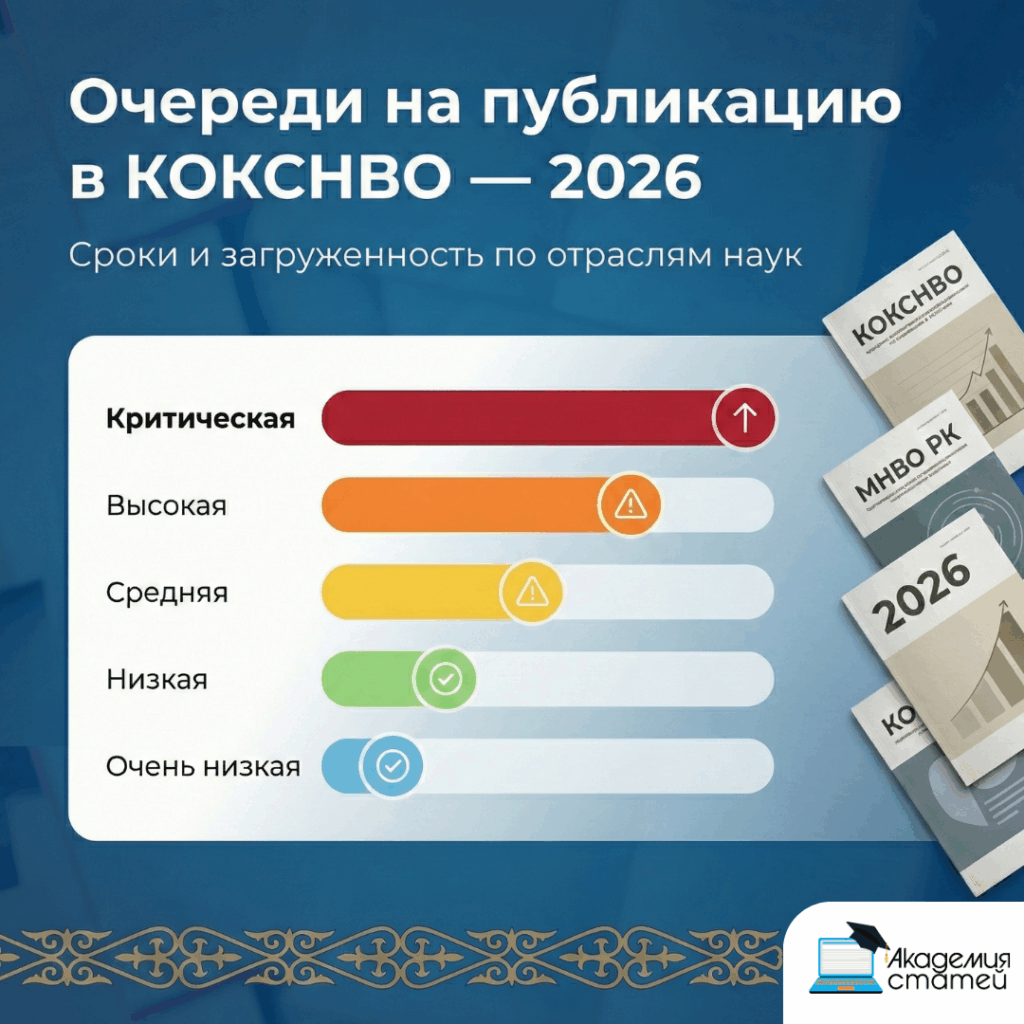
The average turnaround time at the editorial office of a Kazakhstani journal on pedagogy is 12 to 20 months. For economics journals, it ranges from 6 to 12 months—provided the article is accepted on the first submission, is not sent back for revisions, and the journal is not subject to review by the Committee for Scientific and Educational Standards (KOKSNVO).
Now consider the risk: the journal could be removed from the List right in the middle of the waiting period. Or the requirements could be tightened. Or the List could be changed. And you won’t find out about any of this until it’s time to submit your documents.
That's exactly how students lose a year. Or two. Sometimes—the chance to defend their thesis.
We deal with this every day.
We know which journals on the List actually accept articles without a 12-month waiting period. We know which ones are at risk of being removed right now. We know which journal from List 1 will be the best fit for your field and your timeline.
What is included in the turnkey publication service in the journals of the KOKSNVO MNVO of the Republic of Kazakhstan:
- We'll determine the right list for your goal (PhD, associate professor, professor);
- We select a specific journal from the current list based on your specialty and timeframe;
- We check for the risk of exclusion from Scopus before submitting an article;
- We provide support for the article until it is accepted by the editorial board and indexed;
- We will address the reviewers' comments together with you.
You don't do research. You don't check the List every three months. You don't wait alone for a response from the editorial staff.
You're just defending yourself.
📲 Get the complete COKSNVO journal checklist for free
Conclusion
The List of COKSNVO MNVO RK is not just a list of journals. It is a system in which every mistake costs months of work and real money.
One article from List 1 is usually sufficient; more are required from Lists 2 and 3—the exact number depends on your academic trajectory. The list is updated quarterly. Journals are excluded. Requirements are subject to change.
Enter your email address in the form below—we'll send you a complete, up-to-date list of magazines. And if you have any questions, we'll review your situation and provide a specific answer.