
Every year, Kazakhstani scientists risk losing tens of thousands of dollars—not only on service fees, but also on months of waiting, unsuccessful submissions, and journals that ultimately fail to deliver the desired results. The most painful part here isn’t even the money. For a researcher, a single unsuccessful publication can mean a derailed thesis defense, a delayed academic promotion, a lost grant, or another year of uncertainty.
We’ve been working in the field of academic publishing for quite some time now, and over the years we’ve seen the same pattern play out time and again. People don’t come to us because they want to «circumvent» the academic process. They have a deadline, a completed research paper, complex university requirements, and the need to navigate dozens of journals, metrics, and formal requirements. It is precisely at this moment that it’s easiest to be swayed by a low price, a quick publication, or a «100% guarantee.».
The market knows how to sound convincing. Services promise everything at once: risk-free publication, a spot in a top-ranked magazine, quick results, and «partnerships» with publications. They showcase their offices, awards, certificates, and impressive figures. But an office, an award, or a polished presentation alone does not prove that the team is capable of successfully guiding a complex article through every stage—from selecting a journal to peer review and publication.
At the same time, it’s important to be honest: getting published is a complex process. A strong article may require revisions, go through several rounds of peer review, or be rejected by the journal. This is especially true if the topic is niche, the requirements are high, and the deadline is fast approaching. It’s not always anyone’s fault. The problem begins when the complexity of the process is hidden behind empty promises.
This article does not evaluate specific companies or urge anyone to distrust them. Its purpose is to help Kazakhstani researchers better navigate these services, ask the right questions, and avoid wasting years of work, money, and hope due to a lack of transparency.
In this article, you'll learn:
- What types of scientific publishing services are available on the market;
- What kinds of promises do authors respond to most often?;
- What are the three risky scenarios that keep coming up in real reviews?;
- what specifically to look for in independent reviews, communication, and the work process;
- How to tell if a service will be useful to you before you pay for it.
Who Can Help with Scientific Publications, and Why Format Doesn't Guarantee Results
There is no single type of service provider in the academic services market. Different authors need different kinds of assistance: some need only academic editing, while others need help selecting a journal and follow-up support after submission. However, the name of the service, the country of registration, or the number of services listed in the price list do not, in and of themselves, guarantee results.
Foreign brokers with low commission rates
Such intermediaries often work through large networks of contractors, including those from India and other countries with lower costs outsourcing companies. Their proposals may sound very appealing: «Q1 for »10 days,« »guaranteed publication,", «The journal is ready to accept" »article.".
This is exactly where you should be especially careful. Peer review in It's impossible to be honest in a high-quality magazine promise within a few days, but the decision on the adoption of the article The editorial staff accepts submissions; not an intermediary. In complaints about such The same work pattern is often repeated Script: After payment, the author receives the ambiguous status of «article under review,» and communication, explanations and practical support disappear.
International companies with higher average check amounts
Companies from the U.S., the U.K., or EU countries may offer more clear process, more specialized editors and formalized support. However, their services are often are not available to every author: comprehensive maintenance, editing, or Consulting services can cost anywhere from a few thousand dollars, and in In some cases, the check starts at $5 000.
The high price isn't either is a guarantee. It doesn't matter to the author anyway It's important to find out exactly what is included in package, Does the specialized article work? specialist, and which steps are still left to be done by within the limits services.
Freelancers and university researchers
These are often professors, researchers, editors, or translators who are well-versed in one or more specialized fields. They can provide strong, personalized expertise, especially if the article falls within their area of expertise. At the same time, this type of work often depends on a single person’s workload: the process can be slower, and in complex cases, the contractor may not have the resources to provide ongoing support.
Local companies
They typically offer consulting, managerial support, contracts, and a range of services all in one place. This can be a convenient option for an author who wants a straightforward process. However, it’s especially important here to distinguish between marketing and actual expertise: Can the team explain the rationale behind choosing a journal, identify the risks, and show what happens after payment is made?.
None of these formats is automatically reliable or unreliable. The question isn’t whether the intermediary is a foreign entity, a large international company, a freelancer, or a local service. The question is different: Does the service provider understand your research topic, explain the process transparently, and is willing to discuss not only the potential outcome but also the risks?.
What kinds of promises do authors respond to most often, and why should they be wary of them?
When the deadline for a thesis defense, evaluation, or grant application is fast approaching, a quick solution sounds especially appealing. But publishing a research paper is a process, and there are certain stages that a service cannot directly control. That’s exactly why it’s worth taking a closer look at some offers.
«We'll publish it in Q1 within 10–30 days»
In a typical Q1 journal that actually conducts peer review, the process usually takes several months—roughly 2 to 10—depending on the subject matter, the editorial office’s workload, and the number of rounds of revisions. Added to this are manuscript preparation, checking for compliance with the journal’s requirements, responding to reviewers, language and technical editing, formatting the final version, and preparing it for publication.
Ten days may sometimes be enough only for submission or for a publication to formally accept the material—a publication that does virtually no quality review. It is precisely these journals that may exhibit signs of being predatory or may subsequently lose their indexing status. For a Kazakhstani researcher, this is a critical risk: such a publication may not meet the requirements of a specific university, a dissertation defense, a grant competition, or the procedure for obtaining an academic title.
«We'll take care of everything for you; you don't need to get involved.»
The team can indeed handle most of the technical and organizational tasks: analyzing the article, editing, selecting a journal, formatting, submitting the manuscript, and communicating with the editorial board. However, it is impossible—and unnecessary—to completely exclude the author from the process.
The author must provide accurate information, review the content and the final version of the manuscript, approve the choice of journal, and respond to reviewers’ comments. In some cases, the author must also personally confirm a letter from the editorial board or pay the publication fee independently through the journal’s official payment system.
A reputable service does not shift all the work onto the author, but it also does not hide where the author’s involvement is essential. This protects both the research and the researcher.
«Publication in Q1 Scopus for just $1,000»
A low price doesn't always mean there's a problem. But if you're promised full support and publication in Q1 for $1,000, it's worth breaking down the cost into its components.
In many open-access Q1 journals, the official article processing charge (APC) alone often ranges from $1,000 to $2,000 or more. On top of that, there may be additional costs for editing, translation, formatting, journal selection, and peer review support. Therefore, an offer of «all-inclusive for $1 000» requires a clear explanation: which specific journal has been selected, whether its official fee is included in the amount, and exactly what the author is paying for.
A clear answer to these questions does not guarantee publication. But it helps you determine whether you’re looking at a realistic plan or just an attractive price without the full picture.
Three Anonymous Cases: How Scientists Waste Money and Time
Below are three scenarios in which we have removed company names, personal names, contract numbers, and other details that could identify the parties involved. The purpose is not to accuse any specific service, but to highlight patterns that are worth noting before making a payment.
Case 1: An Office, a Contract, and a Five-Year Wait
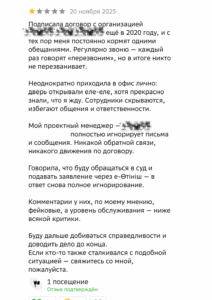
The author signed an official contract with the company back in 2020. The service had an office, managers, and a formally documented partnership: everything seemed reliable. However, according to the author, she was subsequently unable to get a clear understanding of her employment status for years: she called, wrote, and visited the office, only to be told each time that they would call her back.
She received no concrete progress on the project, no explanation for the delay, and no specific plan for next steps. The contract itself and the existence of an office were no guarantee that the author would be supported through to completion.
Here's what's important: don't just check to see if they have a contract and an office. Ask how often you'll receive updates, who is personally responsible for your project, and what will happen if deadlines aren't met.
Case 2. A six-month wait for a journal that the author had not approved
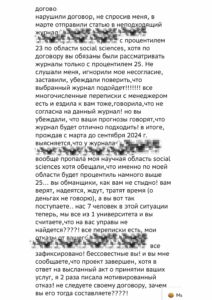
The author sought help with publishing an article and immediately stated her key requirement: the journal must be relevant to her field of study and fall within the desired percentile. According to her, the company suggested a specific journal, but the author disagreed with the choice and explicitly expressed her doubts.
They explained to her that the journal was supposedly a good fit and that the editorial team was better at predicting the outcome. The article was submitted, and the author waited several months. It later turned out that the journal no longer met her needs in her field of study. As a result, she wasted time, even though she had asked not to choose that option before submitting the article.
What’s important here is that the choice of journal cannot be a unilateral decision by the manager. Before submitting, the author must obtain the journal’s name, verify its subject area, check its current status in databases, determine its percentile ranking in their field, and ensure it meets the requirements of the university or the thesis defense committee.
Case 3. $2,000 for Q1 in the medical field, and the provider disappeared after payment
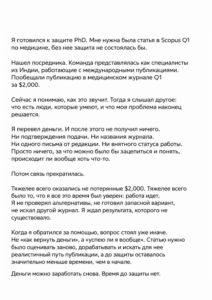
We were approached by a client in the medical field who was preparing to defend his PhD dissertation and needed to publish in a Scopus Q1 journal. He had previously had a negative experience with a foreign intermediary that presented itself as a team from India.
The intermediary promised publication in a Q1 medical journal for $2,000. The client transferred the money but, after payment, did not receive confirmation of submission, the journal’s name, a letter from the editorial board, or a clear update on the status of the work. Communication effectively ceased.
When he came to us, the main problem was no longer just the lost $2,000. Because of the time lost, the deadline before the defense had moved much closer, and the paper needed to be re-evaluated, revised, and a realistic path to publication found.
Here’s what’s important: don’t transfer the full amount until you understand exactly who you’re paying, which journal you’ve chosen, what’s included in the price, and what confirmation you’ll receive after submission. This is especially true when it comes to Q1 in medicine, with a fixed low price and a short deadline.
What to Check Before Choosing a Scientific Publishing Service
It's impossible to guarantee in advance that a specific journal will accept an article. But you can significantly reduce the risk by checking not only the service's advertising but also how it performs in challenging situations.
Independent reviews on trusted platforms
Start not with reviews on the company’s website, but with independent platforms—such as Google Maps, 2GIS, and other services—where real users leave reviews. Positive reviews are helpful, but they often use general phrases like «I liked everything,» «fast,» or «I recommend it.».
On Google Maps and 2GIS, you can sort or filter reviews by low ratings. Take advantage of this: negative reviews often reveal how a company behaves not in ideal circumstances, but when delays occur, a reservation is canceled, or there’s a communication issue.
Focus not on the fact that there is a single complaint, but on recurring patterns: disappearing after receiving payment, lack of status updates, changing the itinerary without prior agreement, delays without explanation, and problems with refunds.
Recommendations from colleagues with similar experience
The strongest recommendation isn't just «someone recommended this company to me,» but rather the experience of a colleague who faced a similar challenge: the same field, a journal of a comparable level, and similar requirements for a thesis defense or grant.
Ask not only about the outcome, but also about the process itself: how long the review took, whether there were any revisions, how often the team communicated, whether the journal gave its approval, and whether the author received any documents from the editorial office.
Speed and Content of Communication
A quick response via messenger is good, but what matters more is whether they address the substance of your inquiry. A high-quality manager doesn’t just say «we’ll do it» or «we guarantee it»; instead, they clarify the topic, the purpose of the publication, the deadline, the university’s requirements, and the status of the manuscript.
You should be wary if someone quotes you a price right away and promises results without asking a single question about the article.
Transparency Regarding the Journal, Deadlines, and Costs
Before paying, you should understand which journal is being considered, why it’s a good fit for your topic, and what its realistic deadlines are. Ask for an explanation of exactly what is included in the price: editing, translation, formatting, submission, responses to reviewers, resubmission, and the publication fee.
If the magazine cannot be named before payment is made, and the timeline is described only as «very soon,» it’s best to postpone the decision.
Practical Benefits Even Before the Contract
A reputable service can demonstrate its expertise even before the contract is signed: explain the weaknesses of an article, identify risks, describe the journal’s requirements, or suggest areas that need improvement.
This doesn't mean the company has to do all the work for free. But after the consultation, the author should have a clearer understanding than before, even if he decides not to continue working with the company.
The Author's Involvement in the Process
A reliable team does not promise to completely «take over» the article and deliver a finished product without your involvement. They will immediately explain where the author’s approval is required: selection of the journal, the final version of the manuscript, responses to substantive comments, correspondence from the editorial board, and, if necessary, payment of the journal’s official fee.
This approach requires a little more attention from the author, but it reduces the risk of losing control over one's own work.
Conclusions: How Not to Waste Time, Money, and Opportunities
Seeking help with a scientific publication: this is not a mistake, nor is it a sign that the author «doesn’t understand the process well enough.» The system of journals, indexing, university requirements, and peer review is indeed complex—especially when an article is needed by a specific deadline.
But the complexity of the process doesn’t make unrealistic promises acceptable. A Q1 turnaround in ten days, a complete lack of author involvement, an unknown journal until payment is made, or a price that doesn’t even cover the publisher’s official fee—these are all reasons to pause and reevaluate the offer.
To protect yourself:
- Check reviews on independent platforms and pay particular attention to recurring negative experiences;
- Ask your colleagues who have dealt with a similar topic and publication requirements for their recommendations;
- Review the journal before submission and check its subject area, status, quartile, and alignment with your goals;
- Please ensure that the deadlines for submission, peer review, and actual publication are clearly distinguished;
- Find out exactly what is included in the price and who pays the journal's official subscription fee;
- Do not transfer the full amount if you do not understand the process, the service provider, or the next steps;
- Keep your contract, correspondence, invoices, and proof of submission.
A reliable service doesn't promise the impossible. It honestly evaluates the article, explains the risks, sets realistic deadlines, and keeps the author involved in the process.
If you have doubts about a journal or its terms of collaboration, or if you’ve already received an offer from an intermediary, start with a free consultation. Sometimes, a single review before you pay can save you not only money but also years of work leading up to your thesis defense or an important competition.